In this guide
Start with the job you need done
A public prompt is a starting draft for instructions. Before copying one into your daily workflow, write down the outcome you need and how you will judge it. A dramatic example can be inspiring while depending on inputs, permissions or a model version you do not have.
This guide is a proposed evaluation method. We have not benchmarked the prompts described here or measured productivity gains. Use a low-risk task whose output you already know how to review.
Free content AI buyer checklist
Choose tools that improve accepted work—not output volume.
Get a checklist for accuracy, edit time, sourcing, brand fit, and cost per accepted asset—plus one briefing a week.
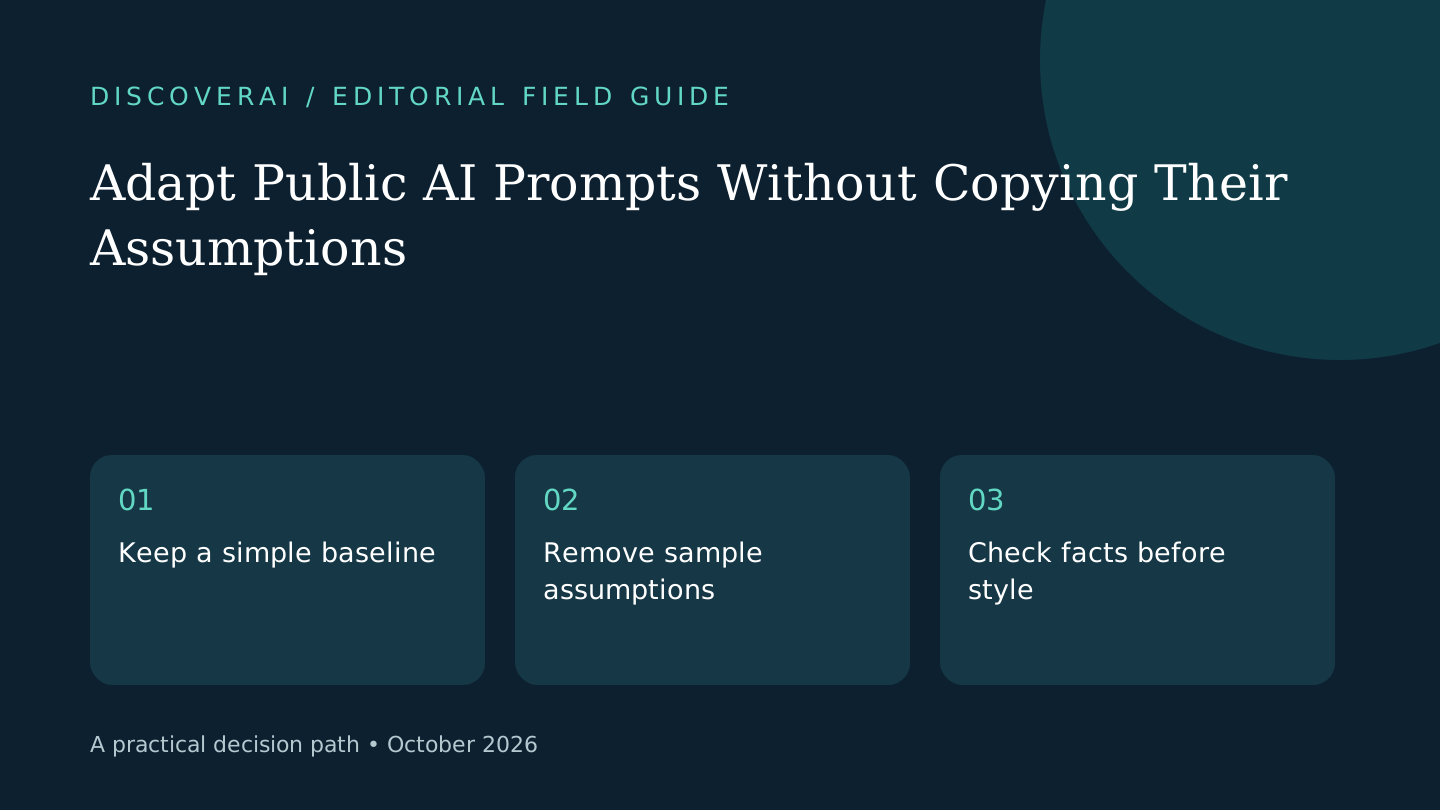
1. Save a simple baseline
Write your own short prompt for a recurring task, such as turning approved product facts into a customer-facing description. Specify audience, format and the facts that must remain unchanged. Save it before trying a library example so you have something concrete to compare.
Public collections such as Prmbr organize examples by task and modality and link to project source. Those are useful discovery paths. They do not establish that an example will fit your assignment or outperform a simpler instruction.
2. Separate instructions from sample content
Read the whole prompt before running it. Highlight names, dates, budgets, target audiences and assumptions about available files. Replace them with approved values or explicit placeholders. Remove references to documents the model cannot actually access.
Keep reusable instructions separate from private assignment material. A shared team template should not carry yesterday’s client name or an API key into the next task. Ask a second person to review the template if it will be reused widely.
3. Define what happens when facts are missing
Add an instruction to identify missing inputs rather than fill them from imagination. Make that behavior testable. Deliberately omit a price or delivery date from a fictional brief and check whether the result invents one.
For example: “Use only the supplied facts. If a required value is absent, write [NEEDS INPUT] and list one question for the reviewer. Preserve all numbers and qualifications.” This is an illustrative instruction, not a guarantee that a model will follow it every time.
4. Compare under similar conditions
Run the baseline and adapted prompt against the same brief, using the same model and settings where possible. Review factual fidelity before style. Record unsupported claims, required edits and the time needed to produce an acceptable deliverable.
Repeat with a second brief that contains a meaningful exception. A prompt that looks excellent on a normal case may erase a restriction in the next one. Do not infer a reliable improvement from a single attractive output.
5. Review actions separately from wording
If an example asks an agent to connect accounts, send messages or update a system, treat those as separate deployment choices. Begin with draft-only output. Check the actual permissions and destination before allowing a connected action.
A plain writing prompt and an account-connected workflow have different operating requirements. Do not let a copied example silently decide those requirements for your team. Record which actions the pilot permits and who reviews the result.
6. Keep a small version record
Save the source URL, date accessed, adapted instructions, model version and acceptance criteria together. Record what changed and why. After a model update, rerun the same sample briefs before replacing an established template.
Use the prompt adaptation worksheet to record this process without signing up. Read the Prmbr review for the library’s scope and limitations, and use the buyer checklist if running a prompt requires a new paid service.
Keep the adapted version only if it makes reviewed work easier to produce. The length of the instructions and the polish of an example are inputs to examine, not success measures.
Transparency
How this guide was checked
Editorial accountability
Who checked this guide
- Evaluation type
- Research-based verification
- Last materially checked
- Evidence
- 2 listed sources
Hands-on testing is identified explicitly. Research-based coverage uses cited product documentation and other named sources; it does not imply every paid plan was used. Read the full methodology.
Editorial basis
What this guidance is based on
- Editorial basis
- Source-led analysis
- Primary references
- 2
- Products covered
- 1
- Last checked
- 2026-10-28
Important limits
- • Features, availability, and pricing can change after publication; confirm consequential details with the provider.
Sources and references
References cited by this article. Check the original source for scope, dates and current terms.
Frequently asked questions
Should I keep the model version in the record?
Yes. The same prompt can behave differently after a model or product change.
What is a good first test?
Use a familiar low-risk task with approved facts and a deliberately missing input.
Are the worksheets gated behind email signup?
No. Both worksheets in this editorial batch are public downloads.
Tools mentioned in this article
Prmbr – Awesome Prompts
Explore Prmbr’s free prompt library, public source and task categories, with a practical method for adapting examples and checking model costs before reuse.
Explore Prmbr’s free prompt library, public source and task categories, with a practical method for adapting examples and checking model costs before reuse.
Read next