In this guide
*This research-based analysis covers Google DeepMind’s September 2026 WeatherNext 3 release. DiscoverAI has not independently validated the model’s forecast skill. Accuracy and speed descriptions are Google-reported unless another source is named.*
The short answer
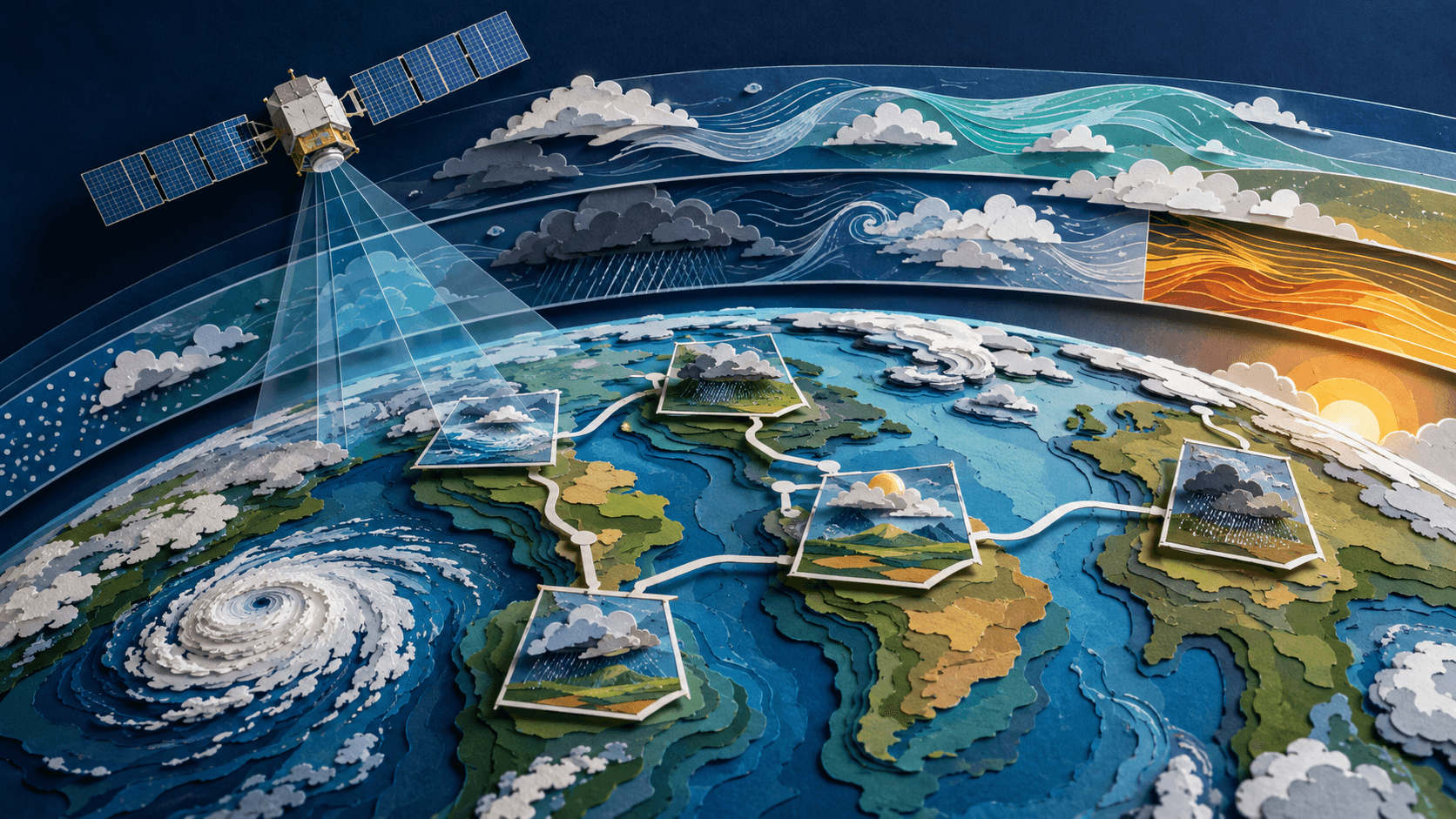
WeatherNext 3 is Google DeepMind’s most advanced global weather AI model and the first in its WeatherNext line designed to generate forecasts every hour of the day. It uses raw satellite imagery directly, increases local resolution, and feeds weather information into Google products and enterprise data services.
The important trend is not “AI predicts weather.” Machine learning has been improving forecasting for years. WeatherNext 3 moves toward a continuously refreshed, globally available layer that can support local decisions in logistics, energy, agriculture, insurance, retail, travel, and public safety. That shortens the distance between a new observation and an operational response.
It does not replace national weather agencies, emergency alerts, domain experts, or organization-specific risk models. A fast forecast is valuable only when users understand uncertainty, verify it against authoritative warnings, and connect it to a tested action policy.
What is new in WeatherNext 3
Previous global forecasting systems commonly initialize on fixed schedules. Google says WeatherNext 3 produces a new global forecast every hour and draws directly from satellite observations. That can help track rapidly changing rain and snow and improve coverage where ground observations are sparse.
Google lists targeted temperature and humidity at five-kilometer resolution and other surface variables, including wind, at ten kilometers. Higher resolution can make forecasts more relevant to local operations, but a five-kilometer grid is not a street-level guarantee. Terrain, coastlines, urban heat, convection, sensors, and rapidly developing hazards can still create meaningful local errors.
WeatherNext 3 is an ensemble model, meaning it produces multiple possible futures rather than one falsely certain line. For decision-makers, the distribution matters. A warehouse operator deciding whether to stage crews needs the chance and range of hazardous conditions—not only the most likely forecast.
Where WeatherNext 3 is available
Google says WeatherNext 3 data is available through BigQuery, Earth Engine, Google Maps Platform, and Google Cloud Storage, and informs products including Search, Maps, and Gemini. Those surfaces serve very different buyers.
A consumer may see a better forecast in a familiar product. A geospatial team can combine weather data with assets and terrain in Earth Engine. An analyst can query historical or forecast data in BigQuery. A logistics or mobility application can use Maps-related services to connect conditions with routes. Availability, update timing, fields, pricing, licenses, service levels, and regional coverage should be confirmed in the documentation for the chosen surface.
Do not assume that a forecast visible in Search has the same contract or granularity as a Cloud dataset. Product packaging is part of the technical evaluation.
Why hourly forecasts matter to businesses
Weather-sensitive decisions decay quickly. A six-hour-old prediction can be adequate for planning and inadequate for dispatch. Hourly global initialization can narrow that gap for delivery windows, renewable generation, outdoor staffing, inventory movement, aviation support, and event operations.
The opportunity is a closed loop: observe, forecast, estimate business impact, recommend an action, confirm the action, and measure the outcome. The risk is automating the middle of that loop without calibrated thresholds or human escalation. A more frequent wrong signal can create more churn, not more resilience.
Teams should translate meteorological variables into business consequences explicitly. “Thirty millimeters of rain” matters differently to a farm, a stadium, a hillside road, and a data center. Local vulnerability and action lead time determine value.
How to evaluate WeatherNext 3
Choose one region, hazard, and business decision. Backtest WeatherNext 3 against authoritative observations and your incumbent forecast over multiple seasons. Measure lead time, probability calibration, false alarms, missed events, spatial error, data latency, availability, and the economic cost of each decision outcome.
Separate ordinary conditions from extremes. Average accuracy can hide the cases that drive most losses. Preserve the full ensemble where possible, document transformations, and test what happens when data arrives late or a field is missing. Require official warning sources for life-safety decisions.
For a live pilot, begin with recommendations rather than automatic control. Let operators see the forecast, uncertainty, current source time, and proposed action. Record overrides and why they occurred. Automation should follow demonstrated calibration and operational reliability, not a compelling global demo.
The broader AI trend
WeatherNext 3 illustrates applied AI becoming infrastructure. The model’s value is not a chat response; it is a continuously updated scientific signal embedded inside databases, maps, consumer products, and operational systems.
That pattern will repeat across energy, materials, biology, mobility, and climate adaptation. As scientific models enter ordinary software, buyers will need evaluation practices that combine model skill with freshness, uncertainty, provenance, service reliability, and human decision design.
The verdict
WeatherNext 3 is significant because hourly, satellite-driven global forecasting can make high-quality weather intelligence more timely and locally useful. Its most promising use is not replacing forecasters but giving organizations a better-updated evidence layer for decisions whose value changes by the hour.
Treat it as decision infrastructure, not weather magic. Backtest the exact region and hazard, retain uncertainty, keep authoritative alerts in the loop, and calculate value from better actions—not from forecast resolution alone.
Transparency
How this guide was checked
Editorial accountability
Who checked this guide
- Evaluation type
- Research-based verification
- Last materially checked
- Evidence
- 4 listed sources
Hands-on testing is identified explicitly. Research-based coverage uses cited product documentation and other named sources; it does not imply every paid plan was used. Read the full methodology.
Editorial basis
What this guidance is based on
- Editorial basis
- Source-led analysis
- Primary references
- 4
- Products covered
- 1
- Last checked
- 2026-09-05
Important limits
- • Features, availability, and pricing can change after publication; confirm consequential details with the provider.
Sources and verification
Product details and claims were checked against the following primary sources.
Frequently asked questions
What is WeatherNext 3?
WeatherNext 3 is Google DeepMind’s global AI weather model designed to generate forecasts every hour using satellite observations and an ensemble of possible outcomes.
How often does WeatherNext 3 update?
Google says the model can generate a new global forecast every hour of the day, supporting faster refreshes for changing conditions.
Where can businesses access WeatherNext 3?
Google lists access through BigQuery, Earth Engine, Google Maps Platform, and Google Cloud Storage. Exact datasets, terms, pricing, and availability depend on the service.
Does WeatherNext 3 replace official weather warnings?
No. Organizations should keep national weather services and official emergency warnings in the loop, especially for life-safety decisions, and validate the model locally before automating actions.
Tools mentioned in this article
Google Gemini
Google's deeply integrated AI assistant with unmatched access to Google's ecosystem
Gemini combines powerful AI with Google's vast data ecosystem — Search, Gmail, Docs, YouTube, and more — for a uniquely integrated experience.
Read next