SciSpace Review 2026: Pricing, Citations, and Fit
A broad research workspace can reduce tool switching, but source coverage, citation support, and correction effort decide whether it saves time.

Bottom line
SciSpace connects scholarly search, PDF chat, extraction, citations, and drafting. Test it with known answers and unsupported questions.
The decision
Should you choose SciSpace?
Shortlist SciSpace only if it improves retrieval and synthesis while preserving exact source traceability and reducing total correction effort.
Best for
Researchers who will verify against original sources; Teams comparing outputs on a known-answer corpus.
Choose something else if
Unreviewed high-stakes synthesis; Restricted uploads without approval
Evidence
Verified research · rating withheld
Pricing checked
See current vendor pricing · 2026-10-04
Free access is available, with limits.
A limited free entry point is available.
Editorial accountability
Who checked this guide
- Evaluation type
- Hands-on evaluation
- Last materially checked
- Evidence
- 5 listed sources
Hands-on testing is identified explicitly. Research-based coverage uses cited product documentation and other named sources; it does not imply every paid plan was used. Read the full methodology.
Editorial freshness
Pricing and material product claims were checked October 4, 2026.
Review evidence
What this guidance is based on
- Evaluation type
- Research-based product assessment
- Material review date
- October 4, 2026
- Evidence
- Current first-party materials and a reproducible buyer test
Important limits
- • DiscoverAI did not run a paid deployment or the described benchmark.
- • Prices, quotas, corpus coverage, models, privacy, and exports can change.
Standardized benchmark coverage
How this review maps to the research benchmark
Citation accuracy
Eligible · not yet runThis review describes source-grounded research, retrieval, or document work. A controlled product run is required before scoring.
Read protocol v2026.10-v1 →Thematic analysis
Not applicableThe reviewed workflow is not qualitative evidence analysis, so a thematic-analysis score would be misleading.
Read protocol v2026.10-v1 →Eligibility is not a product score. DiscoverAI publishes results only after output collection, blinded adjudication, reproducibility checks, and severe-error review.
In this guide
Short answer
SciSpace is worth testing when one connected research workspace could reduce repetitive search, reading, extraction, citation, and drafting work. It is not an authority: verify every consequential statement, quotation, citation, and extraction against the original source.
Pricing and access
Free and paid access are available; verify live prices, quotas, promotions, billing, cancellation, and institutional terms.
Record credits, failed generations, reviewer time, exports, and collaboration needs. Plan labels do not reveal cost per accepted result.
Where it can help—and fail
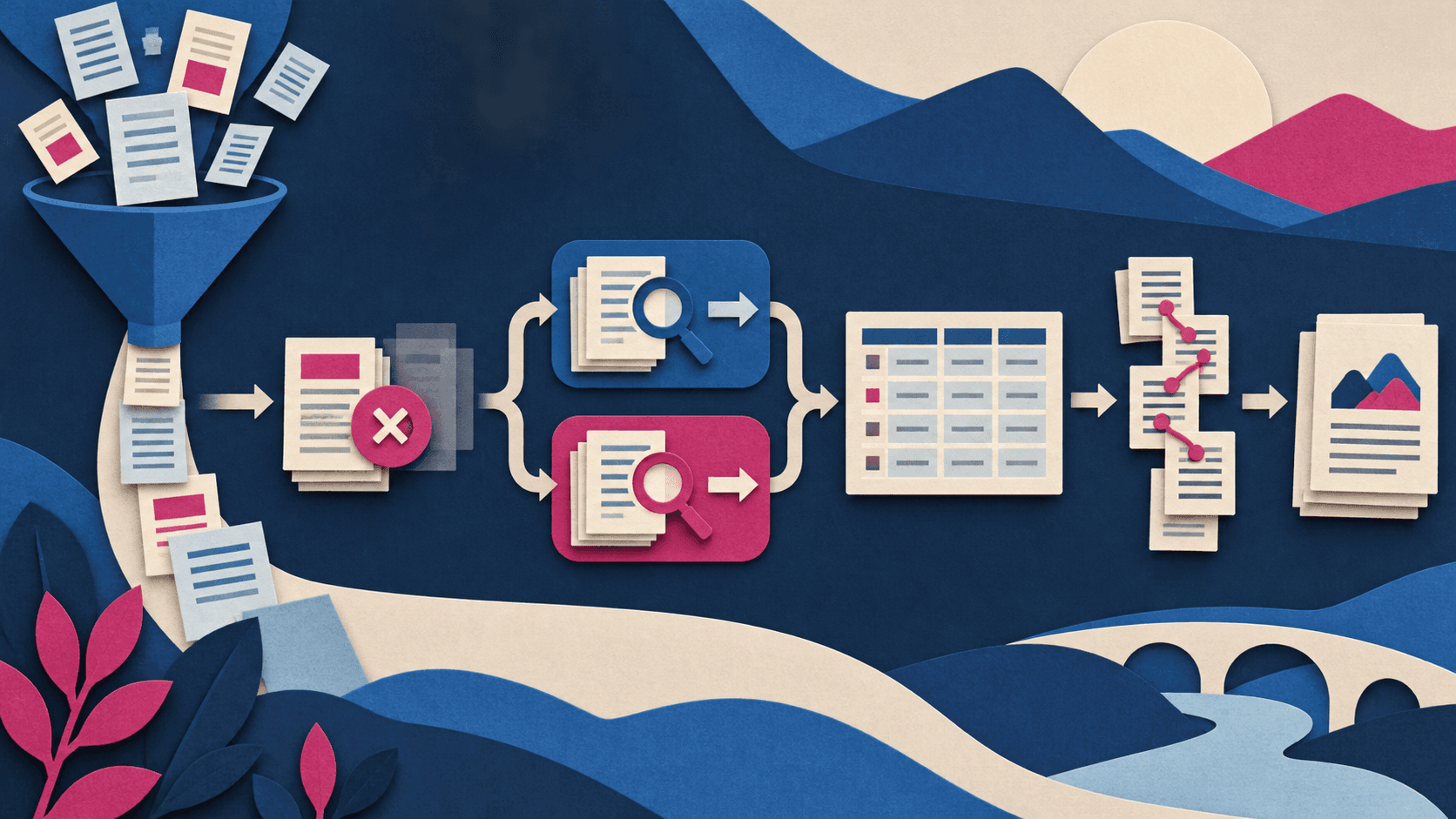
Continuity is the opportunity: a result can move into a library, grounded questions, structured extraction, citations, and a draft without repeated copying. The risk is automation bias. A polished synthesis can omit minority findings, confuse an abstract with full text, attach a real citation to an unsupported sentence, or turn association into causation.
A fair buyer test
Use 40 papers across open, paywalled, scanned, contradictory, retracted, and supplementary-material cases. Ask 25 answer-keyed and eight unanswerable questions; score recall, passage support, quotation fidelity, unsupported claims, corrections, and export.
Use the same corpus, prompts, reviewers, and scoring rules for alternatives. Include contradictory sources and questions the corpus cannot answer. Measure exact passage support, unsupported claims, correction time, and export—not fluency.
Privacy and portability
Review uploaded-data use, retention, deletion, subprocessors, training terms, permissions, and region before adding confidential work. Export a mixed project and verify documents, metadata, notes, citations, folders, tables, and usable formats.
Verdict
Choose SciSpace only if it improves discovery or synthesis while preserving source traceability and reducing total correction effort. A faster draft is not a gain when researchers spend the saved time repairing evidence.
Open the optional evaluation worksheet
Reusable trial worksheet
Test SciSpace before you commit
Turn this review’s buyer test into evidence. Your entries autosave only in this browser and are never added to shared shortlist links.
Confirm the tool meets every must-have workflow and stakeholder requirement.
Review starting point: Researchers who will verify against original sources; Teams comparing outputs on a known-answer corpus; People who need a connected literature workflow
Run the same representative work you would use in production; do not score a polished demo.
Review starting point: Use 40 papers across open, paywalled, scanned, contradictory, retracted, and supplementary-material cases. Ask 25 answer-keyed and eight unanswerable questions; score recall, passage support, quotation fidelity, unsupported claims, corrections, and export. Use the same corpus, prompts, reviewers, and scoring rules for alternatives. Include contradictory sources and questions the corpus cannot answer. Measure exact passage support, unsupported claims, correction time, and export—not fluency.
Calculate the effective cost per accepted result, including usage, review, corrections, and required add-ons.
Review starting point: SciSpace publishes free and paid access, but exact prices, quotas, promotions, and billing options can vary by region and checkout.
Define an acceptance threshold, test known answers and edge cases, and record every correction.
Review starting point: Editorial quality signals: features 0.0/5. Validate these signals in your own work.
Verify what data enters the product, who can access it, how long it is retained, and whether it trains models.
Review starting point: Use approved low-risk data first. Check roles, consent, deletion, subprocessors, model-training settings, and the contract—not only the marketing page.
Test the real handoffs, permissions, failure states, and export path your team depends on.
Review starting point: Zotero, Chrome, PDF upload, Citation exports
Record training, governance, reliability, accessibility, ownership, and change-management risks before rollout.
Review starting point: Citations can be real but fail to support a claim; Search coverage is not automatically complete; Summaries can flatten methods and uncertainty
Loading saved worksheet… · private to this device or your optional account
Community evidence
How verified users put SciSpace to work
Structured, editor-moderated experience—not star ratings. This complements our independent review and never changes its score.
No approved community evidence yet. Be the first verified user to contribute.
Sources and verification
Product details and claims were checked against the following primary sources.
Frequently asked questions
Is SciSpace free?
A limited free entry point is available. Verify live quotas, billing choices, taxes, and checkout terms before relying on them.
Are SciSpace citations always accurate?
No. Open the source, locate the supporting passage, and confirm that scope, date, population, and uncertainty match the generated claim.
Can SciSpace replace a systematic review method?
No. A defensible review still needs documented databases, queries, dates, deduplication, screening, appraisal, conflict handling, and updates.
How should I test SciSpace?
Use a frozen corpus with known answers, contradictory sources, and unanswerable questions; score recall, exact support, unsupported claims, corrections, cost, and export.
Recommended tool
Use SciSpace if this workflow fits your team
It provides a source-centered workflow rather than generic chat alone.
Tools mentioned in this article
SciSpace
Search, read, explain, extract, and draft across scholarly literature
SciSpace combines scholarly search, literature reviews, Chat with PDF, structured extraction, citation tools, and AI writing.
Elicit
A research assistant for finding, screening, and extracting evidence from academic papers
Elicit is strongest for structured literature discovery and evidence extraction, but researchers must still verify coverage, citations, and every consequential conclusion.
Consensus
A practical AI tool for research workflows
Consensus helps professionals improve research workflows with AI-assisted drafting, automation, analysis, or production features.
Litmaps
Discover, visualize, organize, and monitor scholarly literature through citation networks
Litmaps expands seed papers into visual citation maps and alerts researchers to connected literature, but graph proximity is not a quality assessment.
Read next