NVIDIA Isaac ROS 5.0 Brings Agents Into Robot Development—Keep Runtime Safety Separate
An AI agent can help build, simulate, and debug a robot without earning unchecked authority over a moving machine.
Bottom line
Isaac ROS 5.0 adds agent-assisted robotics development and Jetson support. Teams should separate developer acceleration from safety-certified runtime control.
Editorial accountability
Who checked this guide
- Evaluation type
- Research-based verification
- Last materially checked
- Evidence
- 4 listed sources
Hands-on testing is identified explicitly. Research-based coverage uses cited product documentation and other named sources; it does not imply every paid plan was used. Read the full methodology.
Editorial basis
What this guidance is based on
- Editorial basis
- Source-led analysis
- Primary references
- 4
- Products covered
- 1
- Last checked
- 2026-09-28
Important limits
- • DiscoverAI did not test Isaac ROS 5.0 on physical hardware.
- • Package availability, licenses, supported Jetson targets, models, performance, and safety guidance can change.
In this guide
What changed
NVIDIA released Isaac ROS 5.0 on September 22, 2026 at ROSCon. The GPU-accelerated ROS package collection adds agentic development workflows, broader Jetson deployment, updated perception and mapping components, and more open-source physical-AI libraries. NVIDIA frames the release as a way for developers and AI agents to build robotics applications together.
The practical opportunity
Agents can help inspect package documentation, compose launch files, generate tests, analyze logs, reproduce simulation failures, and scaffold perception or navigation pipelines. That can shorten the loop from idea to a testable robot—especially when every proposed change remains reviewable code.
The release should not collapse two different meanings of “agent.” A coding or development agent works on software artifacts. A runtime robot controller perceives and acts in the physical world. The second role has a much higher consequence boundary.
Open source is not one simple label
ROS is an open framework, while Isaac ROS is a collection of NVIDIA packages with package-specific code, model, container, hardware, and license dependencies. Teams should inventory every component and confirm whether it can be modified, redistributed, audited, reproduced, and deployed on the intended hardware.
Safety boundary
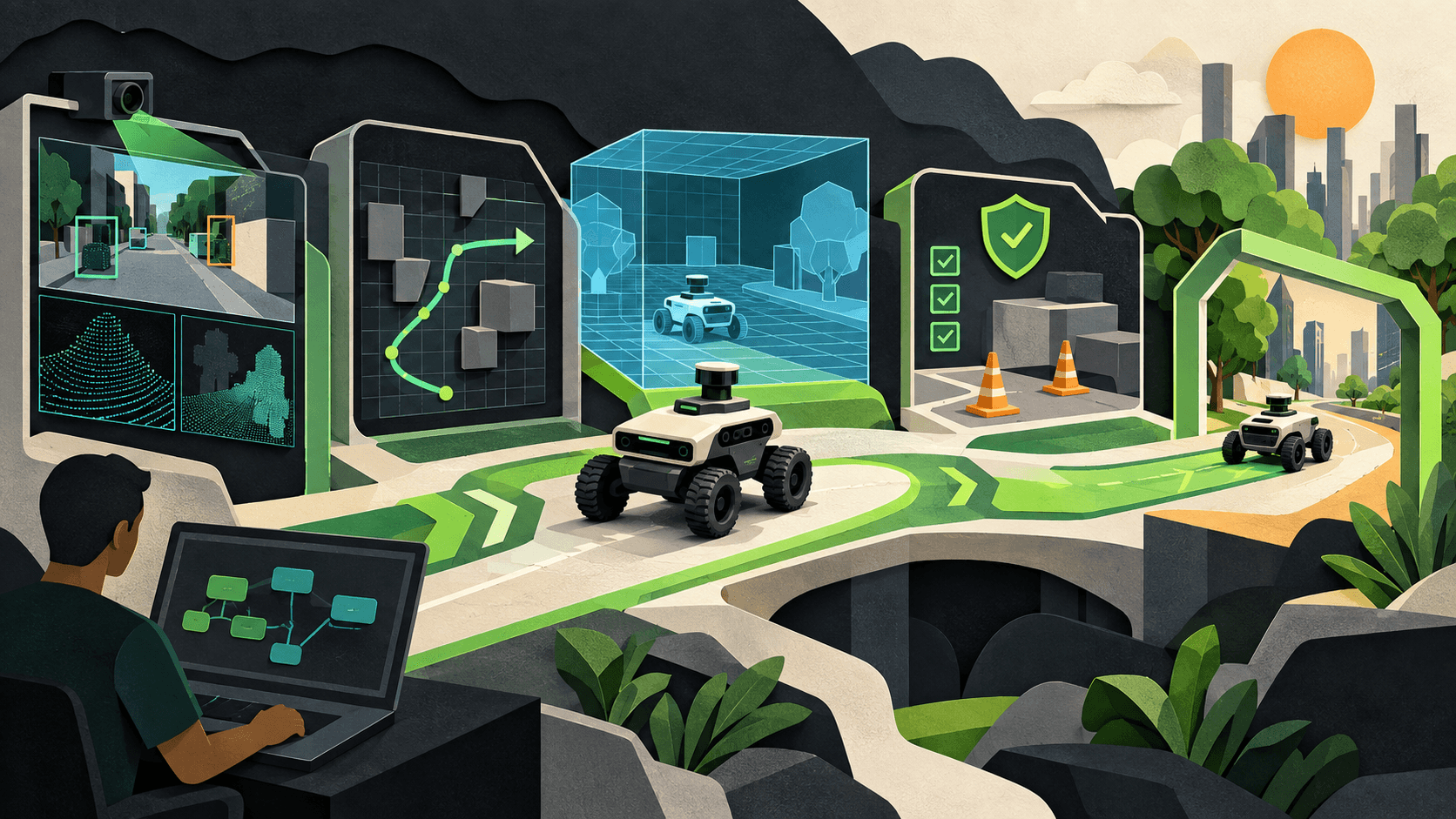
Do not let generated code move directly from a prompt into a physical robot. Pin versions and hardware targets. Review diffs. Run static checks, unit tests, recorded-data replay, simulation, hardware-in-the-loop, and bounded real-world trials. Enforce speed, force, zone, geofence, collision, communications-loss, and emergency-stop limits outside the model's discretion.
Log prompts, generated patches, reviewers, builds, model and package versions, sensor inputs, commands, safety interventions, and incidents. A robot should reach a safe state when the model, network, sensor, accelerator, or agent fails.
A fair evaluation
Give the agent ten representative development issues, including stale documentation, incompatible dependencies, sensor noise, delayed messages, missing frames, a GPU memory limit, and a deliberately unsafe suggestion. Compare time to reviewed fix, test coverage, regression rate, unsafe proposals, reproducibility, and engineer correction time with the existing workflow.
Bottom line
Isaac ROS 5.0 makes agent-assisted robotics development more credible. Treat the agent as a fast contributor inside engineering controls—not as a safety case, an approver, or an exception to physical testing.
Sources and verification
Product details and claims were checked against the following primary sources.
Frequently asked questions
What is NVIDIA Isaac ROS 5.0?
A release of GPU-accelerated packages and development tooling for ROS-based robotics, including agent-assisted workflows and Jetson deployment support.
Does agentic development mean an AI controls the robot?
Not necessarily. A development agent can help write and test software; runtime physical authority should remain separately constrained and validated.
Is every Isaac ROS component open source?
Licenses and dependencies vary by package, model, container, and hardware component. Inventory the exact deployment rather than relying on one umbrella label.
How should teams test agent-generated robot code?
Use reviewable diffs, pinned versions, unit tests, replay, simulation, hardware-in-the-loop, bounded trials, independent safety controls, and logged approvals.
Read next