Maxim AI Review 2026: Agent Evals, Observability, and Pricing
A research-based Maxim AI review covering capabilities, pricing, privacy, limitations, alternatives, and a practical buyer test.
Bottom line
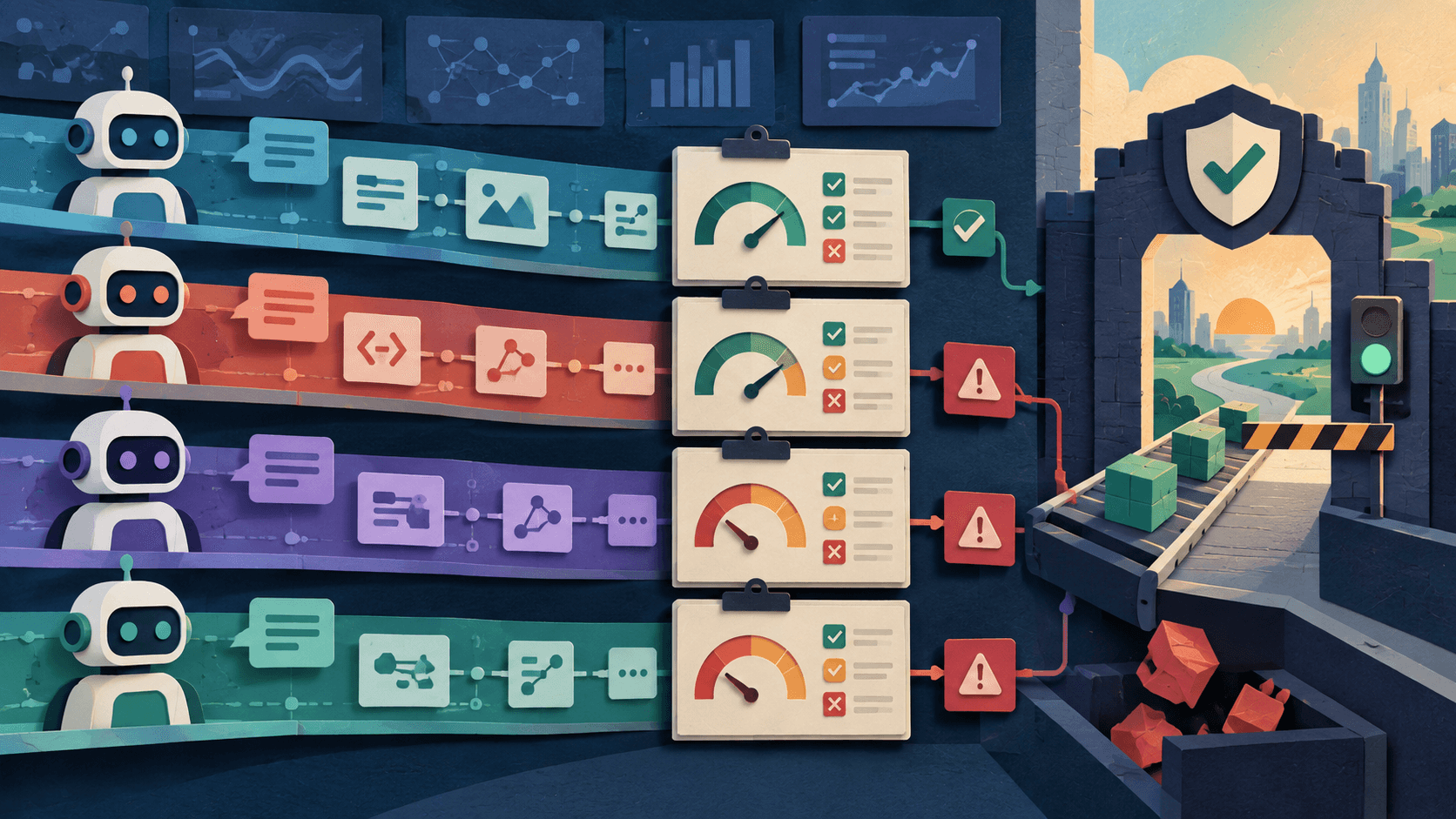
Maxim AI combines prompt experimentation, datasets, simulations, agent evaluations, production observability, online evaluation, and quality dashboards.
Editorial accountability
Who checked this guide
- Evaluation type
- Hands-on evaluation
- Last materially checked
- Evidence
- 4 listed sources
Hands-on testing is identified explicitly. Research-based coverage uses cited product documentation and other named sources; it does not imply every paid plan was used. Read the full methodology.
Editorial freshness
Pricing and material product claims were checked September 13, 2026.
Review evidence
What this guidance is based on
- Review type
- Research-based product assessment
- Material review date
- September 13, 2026
- Evidence
- Current first-party product, pricing, documentation, privacy, security, and open-source material
- Buyer test
- Controlled quality, cost, privacy, reliability, and failure-path evaluation
Important limits
- • DiscoverAI did not complete the proposed long-term paid deployment for this review.
- • Features, prices, limits, security controls, and provider data paths can change; verify the linked first-party pages before purchase.
In this guide
Short answer
Maxim AI is a credible choice when experimentation, agent simulation, evaluation, and production traces need one shared workflow. Its automated scores matter only if they agree with expert labels and detect the failures customers actually experience.
Best for
- Teams unifying AI evals and observability
- Agent simulation and release testing
- Organizations needing collaboration controls
Look elsewhere if
- Teams without expert-labeled cases
- Buyers selecting by evaluator count
- Sensitive production logs on an unsuitable tier
What Maxim AI verifiably does
Maxim documents prompt versioning and deployment, datasets, comparative runs, no-code agents, simulations, agent and component evaluations, CI/CD integration, logs and traces, online evaluations, dashboards, PII management, RBAC, and enterprise SSO, VPC, custom retention, audit logs, and compliance options.
Important limitations
Log allowances and retention vary sharply by plan. Simulation can miss real tool and user behavior, while model judges can be unstable. PII handling, external model calls, and enterprise deployment require architecture and contract review.
Maxim AI pricing
Developer is free for three seats and up to 10,000 monthly logs with three-day retention. Professional is $29 per seat monthly for 100,000 logs and Business $49 for 500,000; $1 per 10,000 log overages are listed on paid tiers. Enterprise is custom. Reviewed September 13, 2026.
A fair buyer test
Create 250 expert-labeled cases with task success, subtle factual errors, unsafe actions, tool failures, long conversations, and cost regressions. Compare human agreement, judge variance, simulation realism, trace diagnosis, log growth, PII controls, and cost per release decision.
Final verdict
Shortlist Maxim AI when evaluation work is fragmented across notebooks, spreadsheets, and telemetry. Require calibrated metrics, useful simulation failures, approved trace handling, predictable log economics, and demonstrably faster release decisions.
This is a research-based product assessment, not a claim of hands-on long-term testing. Product, pricing, privacy, security, and usage claims were checked against the first-party sources below on September 13, 2026. Verify current terms and run the proposed test with approved data before adoption.
Reusable trial worksheet
Test Maxim AI before you commit
Turn this review’s buyer test into evidence. Your entries autosave only in this browser and are never added to shared shortlist links.
Confirm the tool meets every must-have workflow and stakeholder requirement.
Review starting point: Pre-release agent simulation; Cross-functional automated and human evaluation; Connecting production failures to regression tests
Run the same representative work you would use in production; do not score a polished demo.
Review starting point: Create 250 expert-labeled cases with task success, subtle factual errors, unsafe actions, tool failures, long conversations, and cost regressions. Compare human agreement, judge variance, simulation realism, trace diagnosis, log growth, PII controls, and cost per release decision.
Calculate the effective cost per accepted result, including usage, review, corrections, and required add-ons.
Review starting point: Maxim's current evaluation-platform documentation directs buyers to schedule a demo rather than publishing a stable self-serve rate card. The company also publishes Bifrost, a separate Apache-2.0 open-source AI gateway with custom-priced Enterprise controls. Do not treat Bifrost's free license as the price of Maxim's hosted simulation, evaluation, data, and…
Define an acceptance threshold, test known answers and edge cases, and record every correction.
Review starting point: Editorial quality signals: features 4.2/5; AI quality 4.0/5. Validate these signals in your own work.
Verify what data enters the product, who can access it, how long it is retained, and whether it trains models.
Review starting point: Use approved low-risk data first. Check roles, consent, deletion, subprocessors, model-training settings, and the contract—not only the marketing page.
Test the real handoffs, permissions, failure states, and export path your team depends on.
Review starting point: Python, JavaScript, OpenAI, Anthropic, Ragas, HTTP endpoints
Record training, governance, reliability, accessibility, ownership, and change-management risks before rollout.
Review starting point: Hosted platform pricing is not clearly public; Judge and simulation quality require calibration; Wide surface area can add process overhead
Loading saved worksheet… · private to this device or your optional account
Community evidence
How verified users put Maxim AI to work
Structured, editor-moderated experience—not star ratings. This complements our independent review and never changes its score.
No approved community evidence yet. Be the first verified user to contribute.
Sources and verification
Product details and claims were checked against the following primary sources.
Frequently asked questions
What is Maxim AI?
Maxim AI combines prompt experimentation, datasets, simulations, agent evaluations, production observability, online evaluation, and quality dashboards.
How much does Maxim AI cost?
Developer is free for three seats and up to 10,000 monthly logs with three-day retention. Professional is $29 per seat monthly for 100,000 logs and Business $49 for 500,000; $1 per 10,000 log overages are listed on paid tiers. Enterprise is custom. Reviewed September 13, 2026.
Who should use Maxim AI?
Teams unifying AI evals and observability, Agent simulation and release testing, Organizations needing collaboration controls.
What should buyers test before choosing Maxim AI?
Create 250 expert-labeled cases with task success, subtle factual errors, unsafe actions, tool failures, long conversations, and cost regressions. Compare human agreement, judge variance, simulation realism, trace diagnosis, log growth, PII controls, and cost per release decision.
Found this useful?
Get the next one in your inbox.
One five-minute briefing a week: a meaningful change, a practical workflow, and a clearer tool decision—already filtered for lean teams.
Free · one email a week · unsubscribe any time
Recommended tool
Use Maxim AI if this workflow fits your team
Broad pre- and post-release quality workflow
Tools mentioned in this article
Maxim AI
Test agents before release and monitor their quality after deployment
Maxim AI joins prompt experiments, agent simulation, automated and human evaluation, datasets, and production tracing, but meaningful results depend on calibrated rubrics and representative scenarios.
Gentrace
Turn agent traces into repeatable datasets, experiments, evaluations, and error analysis
Gentrace is an AI agent tracing and evaluation platform for organizing test cases, running experiments, deriving quality signals, and investigating failures across development and production traces.
Galileo
Evaluate and monitor generative AI systems
Galileo combines experiments, datasets, custom and built-in metrics, tracing, production monitoring, and guardrails for LLM and agent applications.
Read next
Recommended for you

Galileo AI Review 2026: Evals, Pricing, and Limitations
A research-based Galileo review covering capabilities, pricing, privacy, limitations, alternatives, and a practical buyer test.
Galileo combines experiments, datasets, custom and built-in metrics, tracing, production monitoring, and guardrails for LLM and agent applications.
Read guide
AgentOps Review 2026: Agent Tracing, Pricing, and Limitations
Gentrace Review 2026: AI Agent Evaluation, Tracing, and Fit
Patronus AI Review 2026: Evaluations, Guardrails, Percival, and Pricing