Higgsfield AI Review 2026: Video Quality, Credits, and Commercial Use
A research-based Higgsfield review covering AI video and image models, camera control, characters, credits, commercial use, training terms, and team governance.
Bottom line
Higgsfield offers broad creative model access and cinematic controls, but credit economics, training terms, rights review, and plan-specific governance determine business fit.
The decision
Should you choose Higgsfield AI?
Run a campaign-shaped test and choose the plan only after measuring approved seconds, credit cost, continuity, rights review, and data-use requirements.
Best for
Agencies producing varied campaign assets; Creative teams comparing several video models.
Choose something else if
Sensitive assets on plans with unacceptable training terms; One-format users better served by a specialist
Evidence
Editorial research pending · 8.4/10
Pricing checked
See current vendor pricing · 2026-08-20
Free access is available, with limits.
Yes. The free tier offers limited models and generations; current limits should be checked in the live account.
Editorial accountability
Who checked this guide
- Evaluation type
- Hands-on evaluation
- Last materially checked
- Evidence
- 5 listed sources
Hands-on testing is identified explicitly. Research-based coverage uses cited product documentation and other named sources; it does not imply every paid plan was used. Read the full methodology.
Editorial freshness
Pricing and material product claims were checked August 20, 2026.
Review evidence
What this guidance is based on
- Editorial basis
- Current first-party product, pricing, help, security, privacy, and terms documentation
- Review type
- Research-based product assessment
- Material review date
- August 20, 2026
- Buyer test
- Controlled workflow test with output, correction, cost, permission, and ownership checks
Important limits
- • DiscoverAI did not complete the proposed long-term paid deployment for this research-based review.
- • Features, prices, limits, models, security controls, privacy terms, and usage rights can change; verify the linked first-party pages before purchase.
Standardized benchmark coverage
How this review maps to the research benchmark
Citation accuracy
Not applicableThe reviewed workflow does not produce source-grounded research answers, so a citation score would be misleading.
Read protocol v2026.10-v1 →Thematic analysis
Not applicableThe reviewed workflow is not qualitative evidence analysis, so a thematic-analysis score would be misleading.
Read protocol v2026.10-v1 →Eligibility is not a product score. DiscoverAI publishes results only after output collection, blinded adjudication, reproducibility checks, and severe-error review.
In this guide
Short answer
Higgsfield is worth testing for marketing and creative teams that need cinematic controls, consistent visual assets, and access to many image and video models in one workspace. A limited free tier is available, while paid plans use credits that vary by model, resolution, and duration. Commercial use is permitted, but standard-plan content may be used to improve models; enterprise terms add no-training commitments, indemnification, SSO, and stronger administration.
Best for
- Agencies producing varied campaign assets
- Creative teams comparing several video models
- Businesses able to measure cost per approved asset
Look elsewhere if
- Sensitive assets on plans with unacceptable training terms
- One-format users better served by a specialist
- Teams unable to perform likeness and rights review
What Higgsfield AI verifiably does
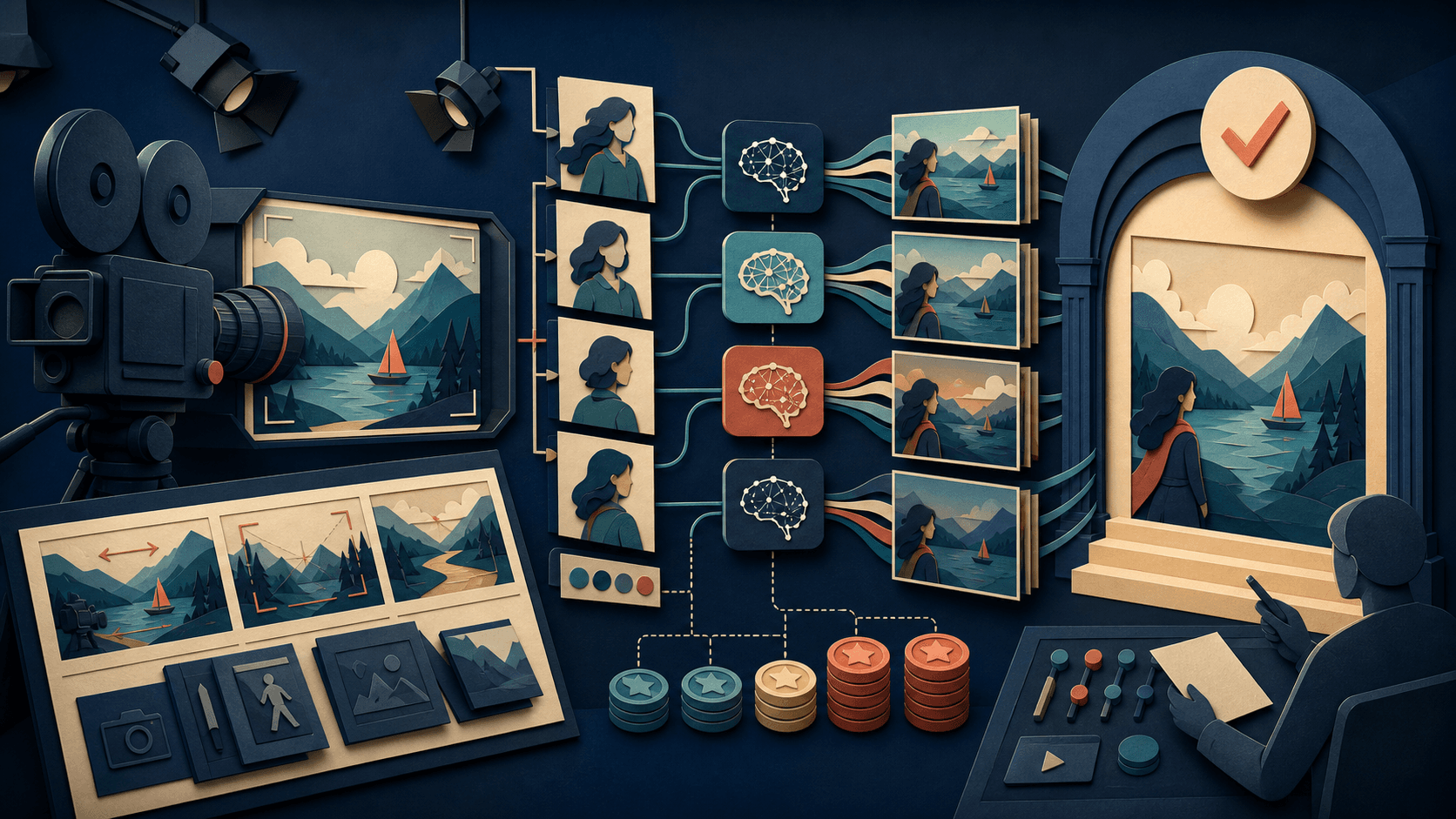
Higgsfield combines its own and third-party image, video, and audio models with camera controls, visual-effects presets, consistent characters, shared assets, parallel generations, team credit pools, and developer access. Its enterprise materials describe creative-tool plugins, SSO, role controls, dedicated capacity, usage reporting, and contractual no-training terms.
Important limitations
Model availability and pricing can change, monthly subscription credits expire, generation costs vary substantially by model and video length, and self-serve work can be used to train Higgsfield models under the current terms. Commercial rights do not guarantee copyright, exclusivity, likeness permission, trademark clearance, factual accuracy, or platform-policy compliance. Team and Scale plans omit some controls reserved for Enterprise.
Pricing snapshot
A limited free tier is available. Paid plan prices and model-specific credit rates are shown dynamically on Higgsfield's pricing page; subscription credits expire at renewal. Verified August 20, 2026.
A fair buyer test
Produce one real campaign brief across three selected models: ten still concepts, five short video variants, a consistent character sequence, and two aspect ratios. Record credits, queue time, failed generations, accepted assets, edit time, visual continuity, accessibility needs, rights review, and cost per approved second. Repeat with a specialist competitor using the same acceptance rubric.
Final verdict
Higgsfield earns a shortlist for agencies and marketing teams that value model breadth and cinematic iteration inside one governed workspace. A specialist tool may be cheaper for one stable format, and sensitive brand assets belong on enterprise terms or outside the service until the data-use terms are acceptable.
This is a research-based assessment, not a claim of hands-on product testing. Product, pricing, security, privacy, and usage claims were checked against the first-party sources below on August 20, 2026. Verify the current contract and run the proposed test with approved data before adopting the product.
Open the optional evaluation worksheet
Reusable trial worksheet
Test Higgsfield AI before you commit
Turn this review’s buyer test into evidence. Your entries autosave only in this browser and are never added to shared shortlist links.
Confirm the tool meets every must-have workflow and stakeholder requirement.
Review starting point: Agencies producing varied campaign assets; Creative teams comparing several video models; Businesses able to measure cost per approved asset
Run the same representative work you would use in production; do not score a polished demo.
Review starting point: Produce one real campaign brief across three selected models: ten still concepts, five short video variants, a consistent character sequence, and two aspect ratios. Record credits, queue time, failed generations, accepted assets, edit time, visual continuity, accessibility needs, rights review, and cost per approved second. Repeat with a specialist competitor using the same acceptance rubric.
Calculate the effective cost per accepted result, including usage, review, corrections, and required add-ons.
Review starting point: A limited free tier is available. Paid plan prices and model-specific credit rates are shown dynamically on Higgsfield's pricing page; subscription credits expire at renewal. Verified August 20, 2026.
Define an acceptance threshold, test known answers and edge cases, and record every correction.
Review starting point: Editorial quality signals: features 4.5/5; AI quality 4.2/5. Validate these signals in your own work.
Verify what data enters the product, who can access it, how long it is retained, and whether it trains models.
Review starting point: Use approved low-risk data first. Check roles, consent, deletion, subprocessors, model-training settings, and the contract—not only the marketing page.
Test the real handoffs, permissions, failure states, and export path your team depends on.
Review starting point: Adobe Premiere Pro, After Effects, Photoshop, DaVinci Resolve, Figma, MCP, CLI
Record training, governance, reliability, accessibility, ownership, and change-management risks before rollout.
Review starting point: Variable credit cost by model and duration; Standard-plan content may be used for training; Important governance and indemnification controls require Enterprise
Loading saved worksheet… · private to this device or your optional account
Community evidence
How verified users put Higgsfield AI to work
Structured, editor-moderated experience—not star ratings. This complements our independent review and never changes its score.
No approved community evidence yet. Be the first verified user to contribute.
Sources and verification
Product details and claims were checked against the following primary sources.
Frequently asked questions
Is Higgsfield free?
Higgsfield offers a limited free tier. There is no separate trial period; paid plans add models, credits, parallel generation, and other capabilities.
Can Higgsfield output be used commercially?
Higgsfield says users may use outputs commercially. That does not remove the need to clear uploaded material, likenesses, trademarks, music, and other third-party rights.
Does Higgsfield train on user content?
Its current terms permit training on standard-plan content. Enterprise agreements state that customer content is not used for training.
How do Higgsfield credits work?
Cost varies by model, resolution, and video duration. Subscription credits expire at renewal; purchased and auto-refill credits have separate expiration rules.
Recommended tool
Use Higgsfield AI if this workflow fits your team
It offers unusually broad model access and production controls for teams creating many visual variants.
Tools mentioned in this article
Higgsfield AI
A multi-model AI video and image workspace with cinematic controls, characters, effects, and team plans
Higgsfield offers broad creative model access and cinematic controls, but credit economics, training terms, rights review, and plan-specific governance determine business fit.
Krea
An AI creative suite for realtime images, video, enhancement, 3D, custom models, and node workflows
Krea combines fast visual exploration with broad production tools, but compute economics, licensing, reference rights, and human art direction remain decisive.
Runway
A practical AI tool for video workflows
Runway helps professionals improve video workflows with AI-assisted drafting, automation, analysis, or production features.
Adobe Firefly
A practical AI tool for image generation workflows
Adobe Firefly helps professionals improve image generation workflows with AI-assisted drafting, automation, analysis, or production features.
Read next