In this guide
What Google announced
On November 18, 2026, Google Labs introduced Stitch Loop, an experimental agent intended to connect a codebase with live product metrics and propose ongoing improvements. This November 21 analysis examines the announcement; we have not used the product.
The official post describes a global waitlist with priority for eligible Google AI Ultra users. It says proposed changes are developed in an isolated sandbox and submitted as GitHub pull requests for human review. Listed areas include security, speed and accessibility. A waitlist is not general availability, and the checked announcement does not establish a production subscription price.
Free AI governance buyer checklist
Know what you’re giving an AI tool access to.
Check data access, security, ownership and how to undo changes. Includes our buyer checklist and the weekly AI briefing.
Why ongoing improvement is a different job
Our editorial interpretation is that the interesting shift is the connection between an observed problem and a proposed code change. Many small teams can create a new page quickly but struggle to explain why users abandon an existing one. Bringing evidence into that conversation could help, provided the evidence is trustworthy.
For example, a decline in completed forms might reflect broken validation, a changed traffic source or simply fewer relevant visitors. Those causes call for different responses. A system that optimizes a metric without checking its definition may improve the dashboard while making the experience worse.
Set a goal someone can audit
Before connecting a tool, write down the outcome, the baseline period and the events that count. For a fictional booking form, the outcome could be a valid request that reaches the team's inbox. Button clicks alone would not establish success.
Specify the changes that remain out of scope: prices, billing rules, customer permissions and tracking consent should not change merely to increase a conversion counter. This is proposed operating guidance, not a claim about controls we verified in Stitch Loop.
Name a person who can review the underlying problem and the resulting patch. The announcement's review boundary is useful only when the reviewer has enough context and time to assess the change.
Read a proposed fix in three passes
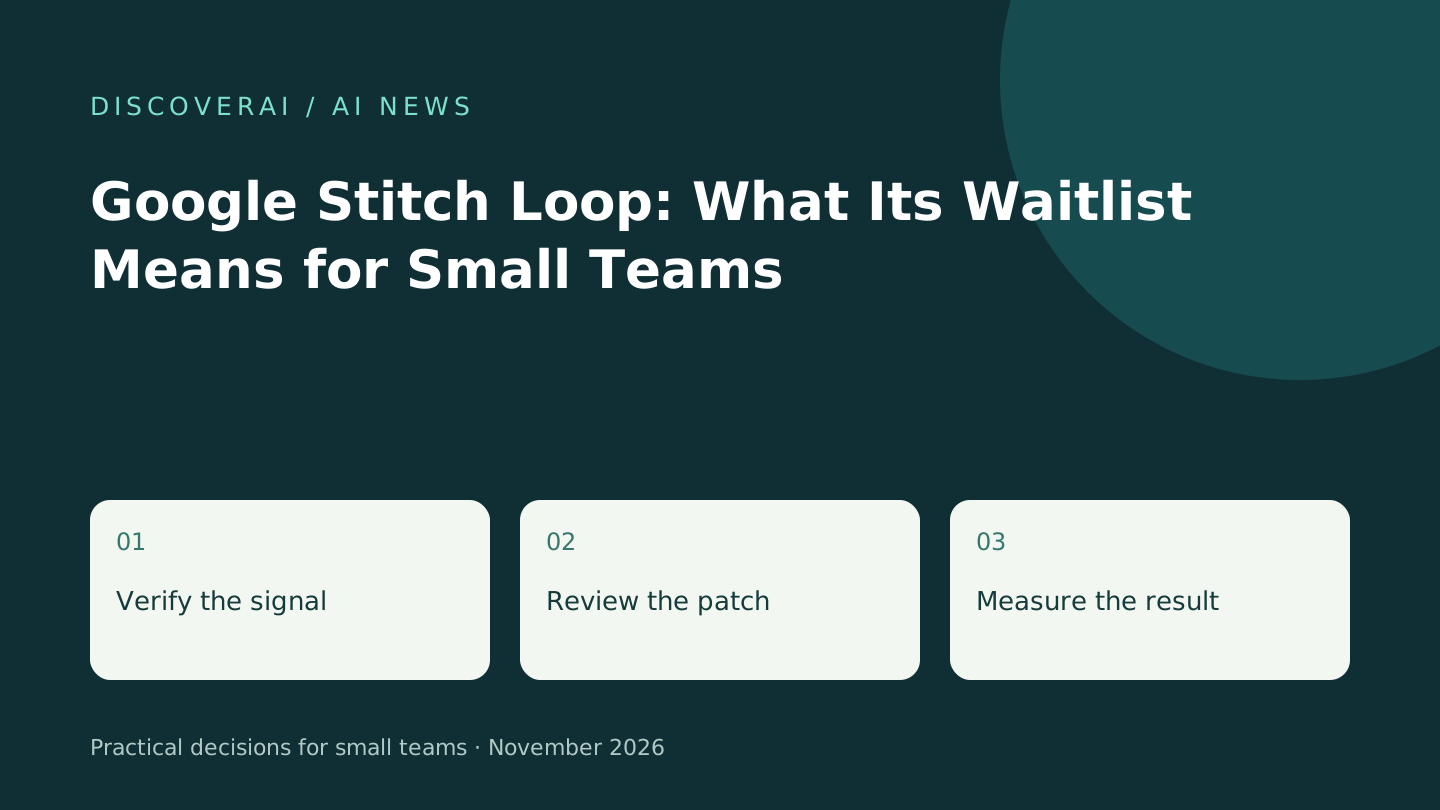
First, inspect the evidence. Does the reported problem reproduce, and does it affect the audience you intend to serve? Second, inspect the implementation for unexpected changes outside that problem. Third, decide how to measure the result and reverse the change if necessary.
A fictional example: an agent proposes removing a required field to increase submissions. The form may become easier, but the missing information could force a follow-up email for every request. Measure the whole process, including staff work, before calling that an improvement.
What remains unproven
The announcement does not demonstrate how the experiment will perform on your application, what access it will require in your setup or whether it will reduce total maintenance effort. Treat promotional capability descriptions as a reason to investigate, not as independent results.
Keep a manual improvement queue while waiting for access. Record reproducible problems, affected pages and the smallest useful correction. That work remains valuable with or without a new agent.
Practical takeaway
Consider the waitlist if your team can supply reliable metrics and review code changes. Start with a bounded, reversible task if access arrives. Our trial scorecard can record acceptance criteria; the release-note guide helps explain only the changes that actually ship.
Transparency
How this guide was checked
About this article
How this article was prepared
- Evaluation type
- Source-based research
- Last reviewed
- Evidence
- 1 listed sources
We label hands-on testing separately. Research-based articles draw on product documentation and other cited sources, rather than direct use of every plan. Read the full methodology.
Editorial basis
Sources and testing
- Editorial basis
- Source-based research
- Primary references
- 1
- Products covered
- 1
- Last checked
- 2026-11-21
Important limits
- • Features, availability and prices can change. Check the provider’s current terms before buying.
Sources and references
References cited by this article. Check the original source for scope, dates and current terms.
Tools mentioned in this article
Google Gemini
Google's deeply integrated AI assistant with unmatched access to Google's ecosystem
Gemini combines powerful AI with Google's vast data ecosystem — Search, Gmail, Docs, YouTube, and more — for a uniquely integrated experience.
Read next