Clay AI Review 2026: Powerful GTM Research, Not a Beginner Shortcut
A buyer-focused review of Clay's enrichment, Claygent research, sequencing, cost model, and operational fit for go-to-market teams.
Bottom line
Clay is a powerful research and orchestration layer for mature go-to-market teams, but its value depends on data strategy, cost controls, CRM hygiene, and a workflow specific enough to justify the complexity.
Editorial accountability
Who checked this guide
- Evaluation type
- Hands-on evaluation
- Last materially checked
- Evidence
- 3 listed sources
Hands-on testing is identified explicitly. Research-based coverage uses cited product documentation and other named sources; it does not imply every paid plan was used. Read the full methodology.
Editorial freshness
Pricing and material product claims were checked August 21, 2026.
Review evidence
What this guidance is based on
- Editorial basis
- Official Clay University, product, and pricing materials
- Review type
- Research-based product assessment
- Buyer test
- 100-account controlled enrichment cohort
Important limits
- • We did not independently run a paid Clay enrichment and sequencing campaign for this review.
- • Data coverage, match rates, and costs vary by market, provider, workflow, and current pricing.
In this guide
Short answer
Clay is best for growth, sales operations, recruiting, and agency teams that need to assemble and act on account or contact intelligence from multiple sources. Its combination of enrichment waterfalls, web research through Claygent, formulas, integrations, and sequencing can support highly specific campaigns. It is not the simplest sales prospecting tool, and teams without a defined market, clean CRM, or cost owner may create an expensive spreadsheet rather than a repeatable revenue system.
Best for
- A GTM operations team enriching and routing high-value accounts
- An agency running repeatable research and personalization workflows
- A sales team with clear segmentation, CRM ownership, and measurable campaign outcomes
Look elsewhere if
- You need only a basic contact database and simple outbound sequence
- Your targeting and offer are still undefined
- Nobody owns data provenance, suppression, credit usage, and CRM writeback
What the product verifiably does
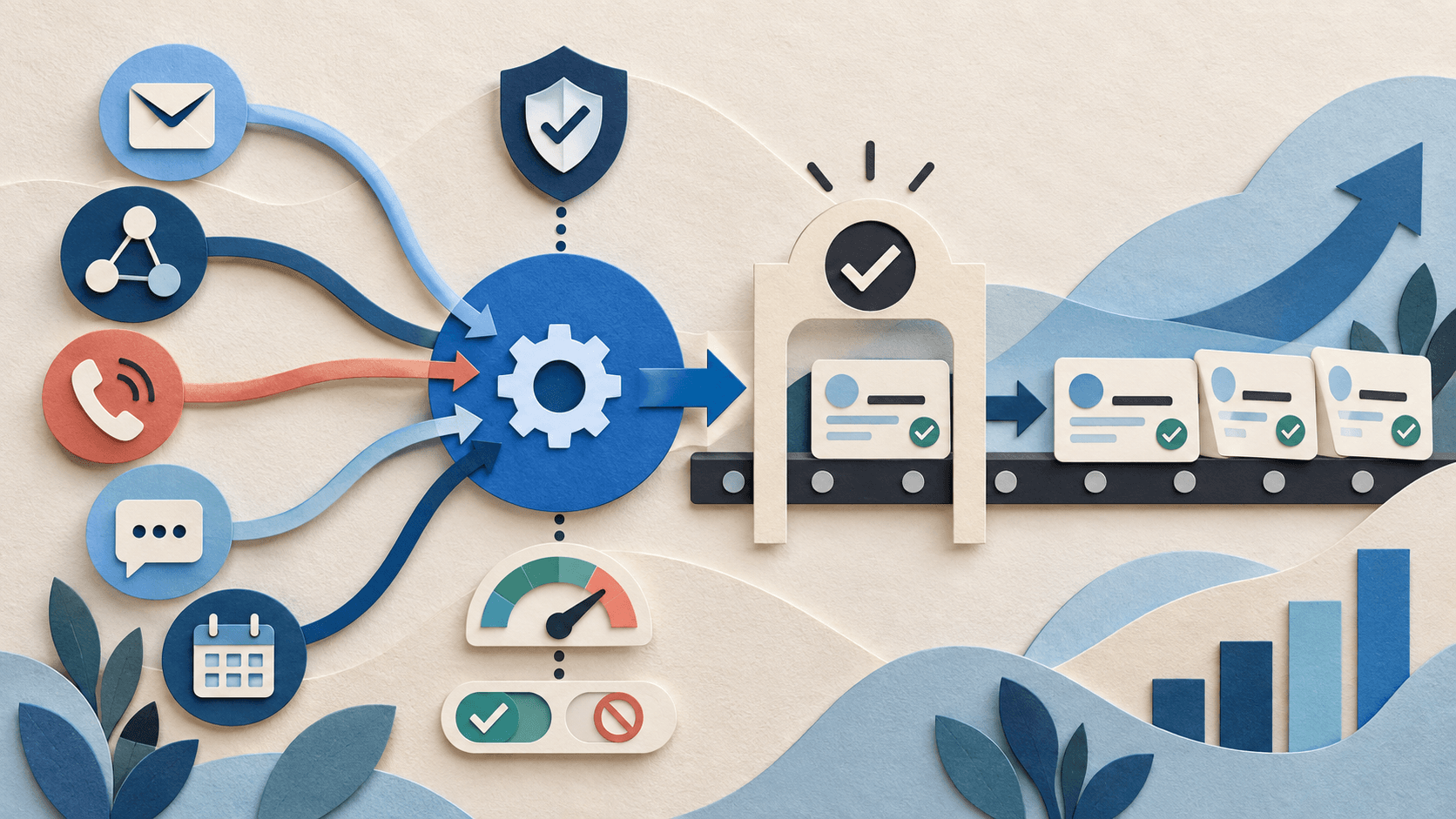
Clay's official learning materials describe enrichment using many data providers, waterfall logic, CRM integrations, formulas, signals, and Claygent. Claygent acts as a web research assistant that can visit sites and return structured insights rather than only matching a static database. Clay also offers a native sequencer that can use enriched data and AI-assisted messaging. This breadth lets a team join research, enrichment, scoring, and action, but every added provider and branch increases the need for governance.
Where it creates value
Clay excels when a generic list is not enough. A team can define a narrow market, enrich companies through multiple sources, research evidence that matters to the offer, score the result, and pass qualified records into an outreach or CRM workflow. This is especially useful for small, high-value markets where relevance matters more than raw sending volume. The table interface also makes intermediate logic visible, which can be easier to audit than an opaque end-to-end agent.
Important limitations
Clay does not fix weak positioning or poor data strategy. AI-generated personalization can be inaccurate, invasive, or generic, and enrichment can return conflicting or stale values. Teams need suppression rules, source tracking, sampling, consent and regional compliance review, and a clear answer for which system is authoritative. Cost is another design constraint: Clay announced a model separating data credits from platform Actions, so an uncontrolled table or automatic refresh can affect more than one usage pool.
Pricing and value
Model Clay economics per qualified opportunity, not per row. Include platform fees, Actions, data credits, external provider costs, email infrastructure, human quality review, and the cost of bad CRM writes. Before adopting a higher plan, run a fixed cohort and calculate verified matches, usable personalized messages, replies, meetings, and pipeline. Current plan names, allowances, and provider prices can change, so use Clay's live calculator and documentation rather than a screenshot from an old review.
A fair test before you buy
Choose 100 accounts from a segment your team already understands. Define five required fields, the acceptable sources for each, a research question Claygent can answer with evidence, and a disqualifying rule. Run the workflow with a hard budget. Manually audit at least 20 records, record false positives and missing data, then send only a controlled subset. Compare qualified replies and meetings with your existing process while tracking total tool and labor cost.
Do not change several variables at once during the trial. Use the same inputs, acceptance criteria, reviewers, and baseline process. Record failures as carefully as successes, including the work needed to correct an output. For team software, also test permissions, export or migration options, cancellation consequences, and what remains usable if the subscription ends.
Final verdict
Clay can be exceptional infrastructure for a sophisticated GTM motion and unnecessary machinery for a simple one. Shortlist it when better research and orchestration are genuine constraints. Start elsewhere when the real problem is unclear positioning, insufficient demand, or undisciplined outbound volume.
This is a research-based assessment, not a claim of hands-on product testing. The sources below establish the documented capabilities; the proposed buyer test is how we recommend validating fit in your own workflow.
Reusable trial worksheet
Test Clay before you commit
Turn this review’s buyer test into evidence. Your entries autosave only in this browser and are never added to shared shortlist links.
Confirm the tool meets every must-have workflow and stakeholder requirement.
Review starting point: Mature B2B GTM teams; High-value account research; RevOps teams consolidating enrichment workflows
Run the same representative work you would use in production; do not score a polished demo.
Review starting point: Run a bounded set of representative tasks with known acceptable outcomes, then compare the result with your current workflow.
Calculate the effective cost per accepted result, including usage, review, corrections, and required add-ons.
Review starting point: Free includes 500 Actions and 100 Data Credits monthly. Launch currently starts at $185/month and Growth at $495/month on monthly terms; annual pricing is lower and Enterprise is custom. Verified August 21, 2026.
Define an acceptance threshold, test known answers and edge cases, and record every correction.
Review starting point: Editorial quality signals: features 4.5/5; AI quality 4.2/5. Validate these signals in your own work.
Verify what data enters the product, who can access it, how long it is retained, and whether it trains models.
Review starting point: Use approved low-risk data first. Check roles, consent, deletion, subprocessors, model-training settings, and the contract—not only the marketing page.
Test the real handoffs, permissions, failure states, and export path your team depends on.
Review starting point: CRMs, Data warehouses, HTTP APIs, Webhooks, Email platforms
Record training, governance, reliability, accessibility, ownership, and change-management risks before rollout.
Review starting point: Two usage currencies complicate forecasting; High self-serve entry price; Data and outreach compliance remain buyer responsibilities
Loading saved worksheet… · private to this device or your optional account
Community evidence
How verified users put Clay to work
Structured, editor-moderated experience—not star ratings. This complements our independent review and never changes its score.
No approved community evidence yet. Be the first verified user to contribute.
Sources and verification
Product details and claims were checked against the following primary sources.
Frequently asked questions
What does Claygent do?
Clay describes Claygent as an AI web research assistant that browses pages and returns insights at scale, allowing teams to supplement conventional enrichment with research tailored to a specific question.
Is Clay a CRM?
Clay is better understood as a GTM data, research, and orchestration layer. It can integrate with CRMs and write enriched data back, but teams still need to define their source of truth and writeback rules.
Is Clay worth it for a small business?
Only when the business has a narrow target, sufficient deal value, and a repeatable research or enrichment problem. A basic prospecting database may be simpler and cheaper for low-complexity outreach.
How should a team control Clay costs?
Use small fixed cohorts, budgets, sampled quality checks, deliberate refresh rules, and cost-per-qualified-opportunity reporting. Account for both data consumption and platform Actions under the current pricing model.
Found this useful?
Get the next one in your inbox.
One five-minute briefing a week: a meaningful change, a practical workflow, and a clearer tool decision—already filtered for lean teams.
Free · one email a week · unsubscribe any time
Recommended tool
Use Clay if this workflow fits your team
Its provider waterfalls and configurable AI research support unusually tailored data operations.
Tools mentioned in this article
Clay
An AI-assisted go-to-market platform for enrichment, signals, research, qualification, CRM workflows, and outreach
Clay can orchestrate sophisticated GTM research and enrichment, but data accuracy, compliance, Actions, Data Credits, human review, and pipeline outcomes determine its value.
Apollo AI
A practical AI tool for sales workflows
Apollo AI helps professionals improve sales workflows with AI-assisted drafting, automation, analysis, or production features.
HubSpot AI
A practical AI tool for sales workflows
HubSpot AI helps professionals improve sales workflows with AI-assisted drafting, automation, analysis, or production features.
Gong
A practical AI tool for sales workflows
Gong helps professionals improve sales workflows with AI-assisted drafting, automation, analysis, or production features.
Copy.ai
A practical AI tool for writing workflows
Copy.ai helps professionals improve writing workflows with AI-assisted drafting, automation, analysis, or production features.
Read next