Best AI Support Agents for B2B SaaS in 2026
Choose the operating model that fits how customers ask for help, then prove durable resolution with your own cases.

Bottom line
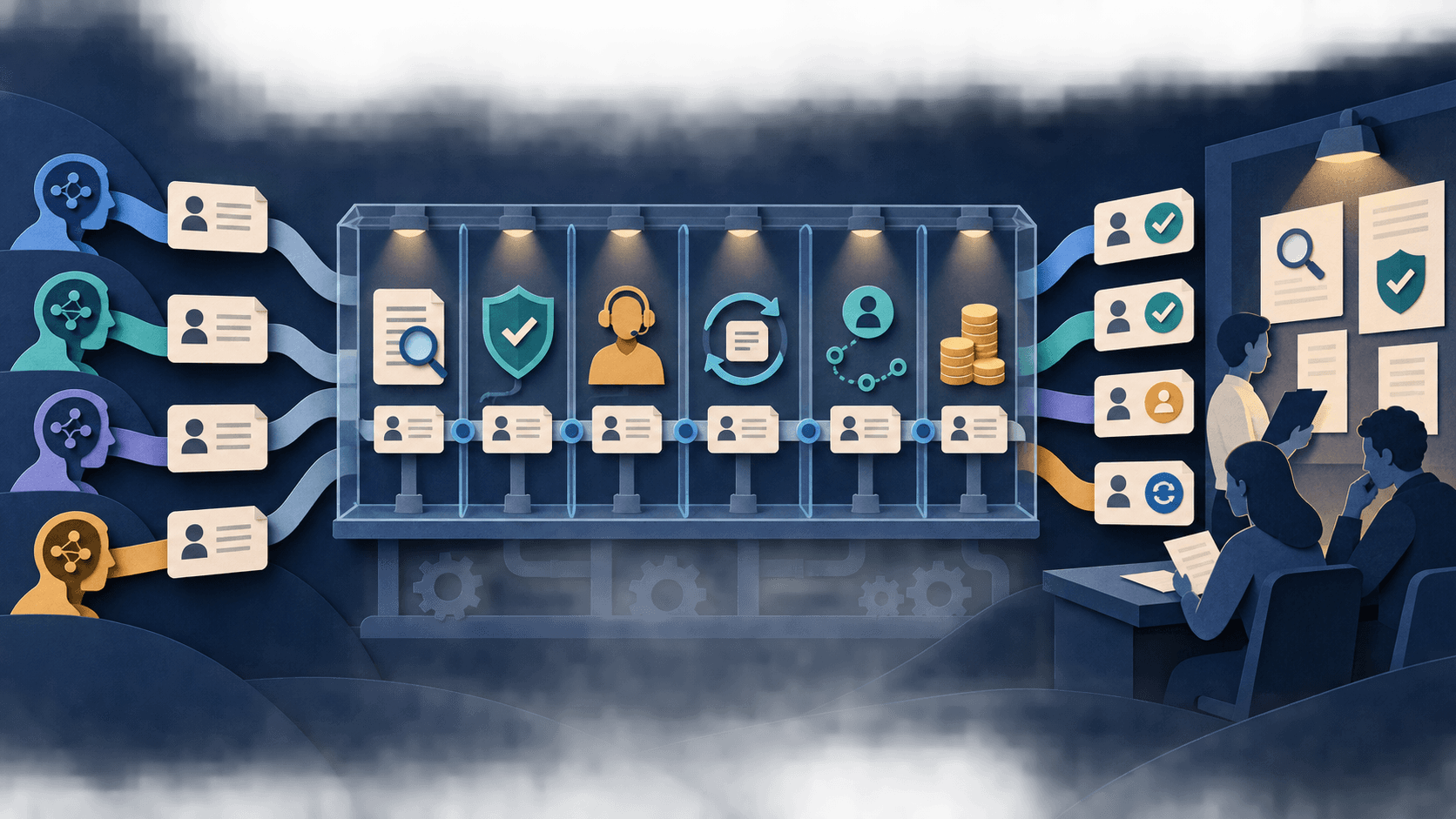
Pylon is the sharpest shortlist when B2B support lives in shared Slack or Teams channels; Intercom fits messenger-centered SaaS support; Sierra fits governed autonomous service; and Cresta fits contact centers combining automation with human-agent assistance. Test finalists on the same cases and choose by durable accepted resolution, escalation quality, customer effort, and cost.
Editorial accountability
Who checked this guide
- Evaluation type
- Research-based verification
- Last materially checked
- Evidence
- 4 listed sources
Hands-on testing is identified explicitly. Research-based coverage uses cited product documentation and other named sources; it does not imply every paid plan was used. Read the full methodology.
Editorial basis
What this guidance is based on
- Editorial basis
- Source-led analysis
- Primary references
- 4
- Products covered
- 4
- Last checked
- 2026-09-26
Important limits
- • This guide uses official product material and a buyer-run evaluation protocol; it does not publish independent comparative benchmark results.
- • Capabilities, channels, models, packaging, pricing, and contract terms can change after the verification date.
- • Results depend on knowledge quality, configuration, integrations, permissions, case mix, and the human support operation.
In this guide
Short answer
Pylon is the sharpest shortlist when B2B support lives in shared Slack or Teams channels; Intercom fits messenger-centered SaaS support; Sierra fits governed autonomous service; and Cresta fits contact centers combining automation with human-agent assistance. Test finalists on the same cases and choose by durable accepted resolution, escalation quality, customer effort, and cost.
Free workflow pilot checklist
Test the workflow before you buy the tool.
Get the buyer checklist, including task, owner, approval, fallback, and time-saved fields—plus one useful briefing a week.
The shortlist
Pylon is purpose-shaped for B2B support across shared customer channels and post-sales context. Intercom offers a broad service suite around its messenger, inbox, help center, workflows, and Fin. Sierra centers a branded autonomous agent that can answer and take bounded actions. Cresta spans virtual agents, real-time assistance for human agents, and contact-center intelligence.
These are different operating models, not four interchangeable chatbots. Begin with where customers already request help, which systems hold account context, which actions the agent may take, and how human support works after escalation.
Best by B2B SaaS need
Choose Pylon when strategic customers expect support inside Slack or Microsoft Teams and the team needs company, account, ticket, and post-sales context together. Choose Intercom when web or in-product messaging, self-service content, and one broad support workspace matter most.
Choose Sierra when the program is designed around a customer-facing autonomous agent with explicit policies, integrations, approvals, and contract-defined outcomes. Choose Cresta when an established contact center needs automation plus human-agent coaching, quality, and operational intelligence. A deterministic help center or workflow may still be the better answer for stable, low-variance needs.
Required capabilities
Inventory channels, languages, identity, account hierarchy, entitlements, knowledge sources, CRM and ticketing, product telemetry, status and incident data, permitted actions, approvals, escalation destinations, analytics, exports, APIs, accessibility, and data regions. Confirm every required capability in the contracted edition; a logo on an integrations page does not establish production depth.
For B2B SaaS specifically, test whether the system distinguishes users from accounts, understands plan and contract context, preserves a shared-channel thread, respects role-based entitlements, detects incidents affecting multiple customers, and hands an escalation to the right support, success, engineering, or billing owner without making the customer repeat the story.
Governance and safety
Map every read and write permission. Separate answering from account changes, credits, refunds, access changes, data deletion, security statements, contractual commitments, and incident communications. Require identity checks, least-privilege credentials, policy enforcement, abstention, approval gates, audit logs, retention and deletion controls, incident response, and a visible human route.
Review model and subprocessor terms, training use, regions, encryption, SSO, roles, auditability, exports, and termination support. Vendor certifications help procurement but do not prove that your configured agent answers correctly or takes authorized actions.
Pricing and total cost
Sales-led plans, seats, conversations, resolutions, outcomes, usage, channels, modules, implementation, support, and overages are not directly comparable. Define the billable unit and test duplicates, multiple intents, reopenings, transfers, partial completion, procedure handoffs, failed actions, and customer-requested humans.
Normalize every quote to total cost per durable accepted resolution. Include knowledge maintenance, integrations, monitoring, reviewer time, corrections, migrations, support, and incident cost. A lower conversation price can be more expensive if cases reopen or humans reconstruct missing context.
A fair 30-day pilot
Freeze a representative, de-identified case set across common, ambiguous, high-value, emotional, adversarial, and failure scenarios. Give finalists the same knowledge snapshot, policy, synthetic account data, permissions, acceptance rules, and escalation staff. Start with offline replay, progress to shadow mode, and use a small approval-gated live cohort only after quality thresholds are met.
Measure eligible cases, durable accepted resolution, factual and action correctness, policy compliance, reopen rate, escalation timing and context, customer effort, latency, reviewer and correction minutes, severe events, and full cost. Preserve transcripts, sources, actions, approvals, configurations, versions, and adjudication.
Recommendation
Most B2B SaaS teams should build a two-product final around their dominant support surface: Pylon versus Intercom for shared-channel or messenger-centered operations, or Sierra versus Cresta for autonomous-service versus contact-center transformation. Do not select from a demo or vendor-reported resolution rate. Select the system that resolves your cases durably, hands off the rest cleanly, stays inside policy, and has an operating cost and owner your team can sustain.
Sources and verification
Product details and claims were checked against the following primary sources.
Frequently asked questions
What is the best AI support agent for B2B SaaS?
Pylon is a strong fit for shared-channel B2B support, Intercom for messenger-centered service, Sierra for governed autonomous agents, and Cresta for broader contact-center operations.
How should a SaaS team compare AI support agents?
Use identical historical cases, knowledge, policies, permissions, and escalation staff; compare durable resolution, correctness, handoff quality, effort, severe failures, and total cost.
Is containment the same as resolution?
No. A contained case may be abandoned or incorrectly closed. Require evidence that the customer's need was correctly and durably handled inside a declared reopen window.
Should an AI support agent change customer accounts?
Only through least-privilege actions with identity checks, policy controls, logs, rollback, and explicit approval for consequential changes.
Recommended tool
Use Pylon if this workflow fits your team
Pylon is a strong shortlist for B2B software companies that support customers across Slack, Teams, email, chat, phone, and shared operational systems. Its distinctive opportunity is turning those fragmented conversations into account context that humans and agents can use. The tradeoff is a broad data and action surface, sales-led core pricing, and a still-evolving Agentic Support credit model.
Tools mentioned in this article
Pylon
Pylon is a strong shortlist for B2B software companies that support customers across Slack, Teams, email, chat, phone, and shared operational systems
Pylon is a strong shortlist for B2B software companies that support customers across Slack, Teams, email, chat, phone, and shared operational systems. Its distinctive opportunity is turning those fragmented conversations into account context that humans and agents can use. The tradeoff is a broad data and action surface, sales-led core pricing, and a still-evolving Agentic Support credit model.
Intercom Fin
A practical AI tool for customer support workflows
Intercom Fin helps professionals improve customer support workflows with AI-assisted drafting, automation, analysis, or production features.
Sierra
Sierra is a serious shortlist for large customer-experience teams that want an AI agent to resolve—not merely summarize—customer requests across several channels
Sierra is a serious shortlist for large customer-experience teams that want an AI agent to resolve—not merely summarize—customer requests across several channels. Its distinctive commercial idea is outcome-based pricing. That alignment is valuable only when the contract defines a successful outcome, exclusions, reversals, quality thresholds, and disputed attribution with unusual precision.
Cresta
Cresta is worth evaluating for large contact centers that want AI agents, real-time human-agent guidance, and conversation intelligence on one enterprise platform
Cresta is worth evaluating for large contact centers that want AI agents, real-time human-agent guidance, and conversation intelligence on one enterprise platform. The opportunity is a shared learning loop across automated and human conversations. The risk is optimizing a vendor score or containment rate while customer outcomes, consent, fairness, or escalation quality deteriorate.
Read next