AudioPen Review 2026: Voice Drafts, Pricing, and Privacy
A research-based AudioPen review covering spoken drafts, prepaid Prime pricing, offline transcription versus cloud rewriting, alternatives, and a buyer test.

Bottom line
A research-based AudioPen review covering spoken drafts, prepaid Prime pricing, offline transcription versus cloud rewriting, alternatives, and a buyer test.
The decision
Should you choose AudioPen?
Evaluate ten non-sensitive briefs and measure correction time before committing.
Best for
Individuals drafting short notes and messages from speech.
Choose something else if
Unreviewed confidential records or automatic commitments
Evidence
Verified research · rating withheld
Pricing checked
See current vendor pricing · 2026-10-09
Free access is available, with limits.
Free recordings up to 3 minutes; voice typing has limited sessions.
In this guide
Short answer
AudioPen is worth trying when you think clearly aloud but spend too long turning those thoughts into readable writing. Its strongest evaluation case is a personal drafting routine. It is less suitable as the authoritative record of a multi-person meeting. This is a research-based review; we have not tested the product and numerical ratings are withheld.
What it does
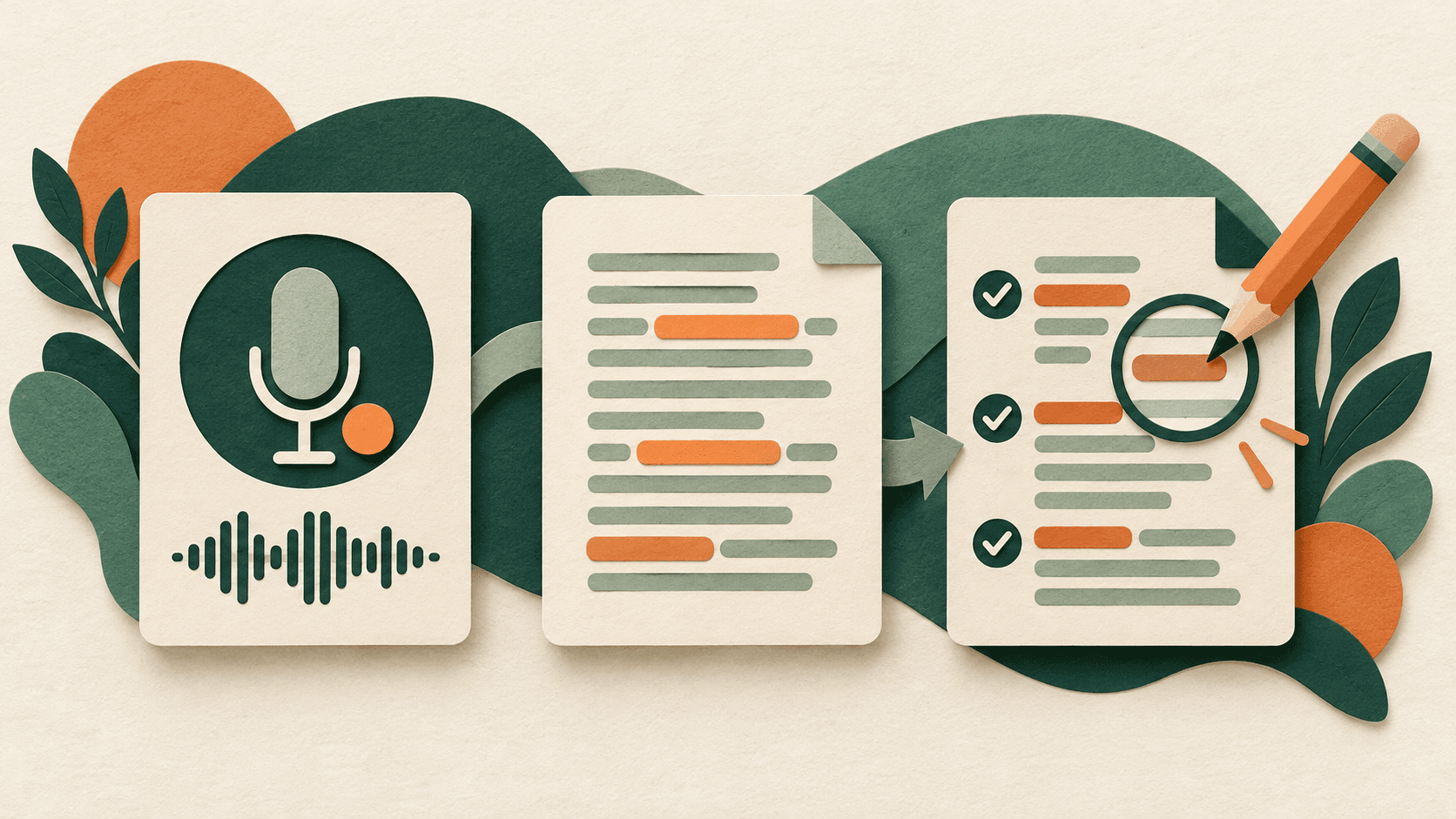
The product overview describes transcription followed by optional rewriting in a selected style, with control over rewrite intensity. The appeal is starting from your own spoken material rather than generating a topic from a blank prompt.
The practical risk is a polished draft that changes the speaker’s intent. Compare the original transcript with the rewrite, especially for names, amounts, exceptions and uncertain statements. These are our evaluation criteria, not errors observed in a product test.
Pricing checked October 9, 2026
The pricing page lists Free with recordings up to three minutes and limited voice-typing sessions. Prime is $33 for three months, $99 for one year or $159 for two years. The displayed monthly equivalents are not verified month-to-month offers.
Prime lists recordings up to fifteen minutes, additional note-processing features and bounded file-upload allowances. Confirm checkout terms, tax and current limits. Start with a short free recording; pay for a demonstrated requirement rather than a hoped-for habit.
Offline does not cover every step
The FAQ distinguishes optional on-device transcription in supported apps from cloud-based AI rewriting. The web and extension paths use cloud transcription. Choosing offline transcription therefore does not establish that the full rewritten-note workflow stays on the device.
Review the privacy policy and enabled features before using confidential material. A local microphone and a personal note do not automatically make the processing private. Our initial test recommendation is to use invented, non-sensitive examples.
Strengths and tradeoffs
Potential strengths are a focused speak-to-draft loop, adjustable rewriting and keeping source speech close to the writing process. Tradeoffs are semantic review, paid feature boundaries and dependence on the chosen processing path. We do not infer accuracy or time savings from vendor testimonials.
Compare [Letterly](/tools/letterly) for another capture-and-rewrite candidate, [Wispr Flow](/tools/wispr-flow) for dictation across applications and [Voicenotes](/tools/voicenotes) for a note-library workflow. These are fit comparisons, not measured rankings.
Proposed buyer test
Record ten short invented briefs. Include a corrected date, a negative instruction, a tentative estimate and an unfamiliar name. Keep a manual checklist of details that must survive. Review both the transcript and rewritten text against that checklist.
Measure accepted drafts, missing qualifiers, added claims and total correction time. Repeat a few examples in the setting where you normally work. Compare the whole process with typing the same kind of brief directly.
Before migrating an archive, test retrieval, export and deletion with disposable notes. Inspect the resulting files rather than assuming that a successful download preserves every attachment or original reference.
Verdict
Shortlist AudioPen for individual idea capture when editing from speech feels easier than composing from scratch. Delay a paid commitment until the accepted-draft routine is useful several times in a normal week. Our [voice-to-draft checklist](/articles/turn-voice-notes-into-accurate-ai-drafts) provides a tool-independent review method.
Transparency
How this guide was checked
Editorial accountability
Who checked this guide
- Evaluation type
- Hands-on evaluation
- Last materially checked
- Evidence
- 4 listed sources
Hands-on testing is identified explicitly. Research-based coverage uses cited product documentation and other named sources; it does not imply every paid plan was used. Read the full methodology.
Editorial freshness
Pricing and material product claims were checked October 9, 2026.
Review evidence
What this guidance is based on
- Evaluation type
- Official-source research; no hands-on testing
- Sources checked
- October 9, 2026
Important limits
- • Product capabilities and outcomes have not been independently tested by DiscoverAI.
- • Prices, availability and policies may change; proposed tests are reader-run exercises.
Standardized benchmark coverage
How this review maps to the research benchmark
Citation accuracy
Not applicableThe reviewed workflow does not produce source-grounded research answers, so a citation score would be misleading.
Read protocol v2026.10-v1 →Thematic analysis
Not applicableThe reviewed workflow is not qualitative evidence analysis, so a thematic-analysis score would be misleading.
Read protocol v2026.10-v1 →Eligibility is not a product score. DiscoverAI publishes results only after output collection, blinded adjudication, reproducibility checks, and severe-error review.
Open the optional evaluation worksheet
Reusable trial worksheet
Test AudioPen before you commit
Turn this review’s buyer test into evidence. Your entries autosave only in this browser and are never added to shared shortlist links.
Confirm the tool meets every must-have workflow and stakeholder requirement.
Review starting point: Individuals drafting short notes and messages from speech
Run the same representative work you would use in production; do not score a polished demo.
Review starting point: Run a bounded set of representative tasks with known acceptable outcomes, then compare the result with your current workflow.
Calculate the effective cost per accepted result, including usage, review, corrections, and required add-ons.
Review starting point: Free; Prime $33/3 months, $99/year or $159/2 years. Prepaid term equivalents are not monthly checkout rates.
Define an acceptance threshold, test known answers and edge cases, and record every correction.
Review starting point: Editorial quality signals: features 0.0/5. Validate these signals in your own work.
Verify what data enters the product, who can access it, how long it is retained, and whether it trains models.
Review starting point: Use approved low-risk data first. Check roles, consent, deletion, subprocessors, model-training settings, and the contract—not only the marketing page.
Test the real handoffs, permissions, failure states, and export path your team depends on.
Review starting point: AudioPen integration requirements are not fully structured in this review; list every required system and test each connection.
Record training, governance, reliability, accessibility, ownership, and change-management risks before rollout.
Review starting point: Rewrites require meaning checks; Processing and integration permissions need review; Plan limits require confirmation
Loading saved worksheet… · private to this device or your optional account
Community evidence
How verified users put AudioPen to work
Structured, editor-moderated experience—not star ratings. This complements our independent review and never changes its score.
No approved community evidence yet. Be the first verified user to contribute.
Sources and verification
Product details and claims were checked against the following primary sources.
Frequently asked questions
Does AudioPen have a free plan?
The pricing page lists Free with recordings up to three minutes and limited voice typing.
Is Prime billed monthly?
The retrieved offers are prepaid three-month, one-year and two-year terms, not confirmed monthly subscriptions.
Does offline transcription mean offline rewriting?
No. The FAQ says the AI rewrite step uses the cloud.
Is this a hands-on review?
No. Official sources support the assessment; numerical ratings are withheld.
Tools mentioned in this article
AudioPen
Turn spoken ideas into reviewed written drafts
A research-based AudioPen review covering spoken drafts, prepaid Prime pricing, offline transcription versus cloud rewriting, alternatives, and a buyer test.
Letterly
Turn spoken ideas into reviewed written drafts
A research-based Letterly review of voice capture, rewrites, integrations, pricing uncertainty, privacy, alternatives, and a practical evaluation checklist.
Wispr Flow
Wispr Flow turns speech into edited text across desktop and mobile apps, using context, custom vocabulary, snippets, and organizational controls
Wispr Flow turns speech into edited text across desktop and mobile apps, using context, custom vocabulary, snippets, and organizational controls.
Voicenotes
A voice-first AI notebook for meetings, memos, transcription, recall, and connected assistants
Voicenotes can turn spoken ideas and meetings into searchable knowledge, but consent, transcription accuracy, retention, subprocessors, and connected-tool data paths need review.
Read next